Assess tool permissions, data access and high-impact actions before expanding agent autonomy. Encased.ai combines workspace policy checks and human review with a customer-side broker-and-container isolation candidate. Start with a fixed-scope AI agent security audit, or inspect the evidence first.
Containment is not certified. Python 0.3.2 is not production-qualified. Linux Docker probes passed 9/9 on 10 November 2026 in a builder-run test; independent review remains pending.
AI coding tools made agent prototypes cheap. Security review, validation and ownership did not get faster—so promising agents wait weeks for approval to touch real data and APIs.
Map what it can reach. Tools, credentials, destinations and irreversible actions, per agent.
Gate what it can change. Deterministic policy plus named human approval for refunds, exports and deletes.
Hand reviewers evidence. Written findings and a guardrail blueprint your security team can assess.
The audit shortens the review conversation; it does not certify your deployment or Encased’s containment.
Agentic AI security protects systems where AI models select tools and take actions across data, services and infrastructure. Beyond whether a response is safe, ask: which identity authorises the action, what can it reach, who can approve it, and what prevents execution when a policy says no?
A policy decision is not an enforced boundary. Encased’s workspace proposal and human-review flow has been exercised. Its customer-side isolation candidate now has a 9/9 builder-run Linux probe result dated 10 November 2026; independent review and deployment-specific qualification are still required before production containment claims can be made.
Inspect the credentialless, network-none worker and trusted host broker. See controlled effects, the builder-run Linux results, remaining bypass risks and qualification gaps.
Review up to 10 agents, permissions and data paths. Receive written findings and a guardrail blueprint, with a dedicated policy and proposal-review workspace.
Evidence to request from an agentic AI security provider
Ask for deployment-specific results, not just a policy demo: which actions were refused, what happened when approval timed out, and whether untrusted code could reach credentials or the network outside the approved path. Separate the provider’s own tests from an independent assessment.
Recorded local tests passed
73 / 82
Linux Docker-gated probes passed
9/9
Independent conclusion
Pending
Builder-recorded evidence for Python 0.3.2: the local suite dated 22 October 2026 recorded 73 passes and 9 skipped Docker probes out of 82 tests. Those nine probes subsequently passed 9/9 on 10 November 2026 (Ubuntu 24.04.5 · Docker 29.1.3 · cgroup v2), with 0 failed and 0 skipped. The Linux run is builder evidence, not independent review or production acceptance.
Tickets, emails and retrieved pages can steer tool use.
Test hostile inputs and requested effects. The broker does not reliably detect prompt injection or semantic drift.
Data leaving approved paths
Outbound calls can carry sensitive data.
Configured broker transports require exact approved domains and global IPs/CIDRs, pin TLS connections and refuse redirects. Other execution paths are not covered by those transports.
High-impact tool actions
A permitted identity can still request a harmful SQL mutation or external action.
Apply explicit tool policies and require authorised human decisions. The calling system must enforce the decision before execution.
Runaway execution
Retries, recursion and spawned work consume resources.
Inspect customer-side budgets and container resource limits. Monitored-action allowances are not hard token or spending caps.
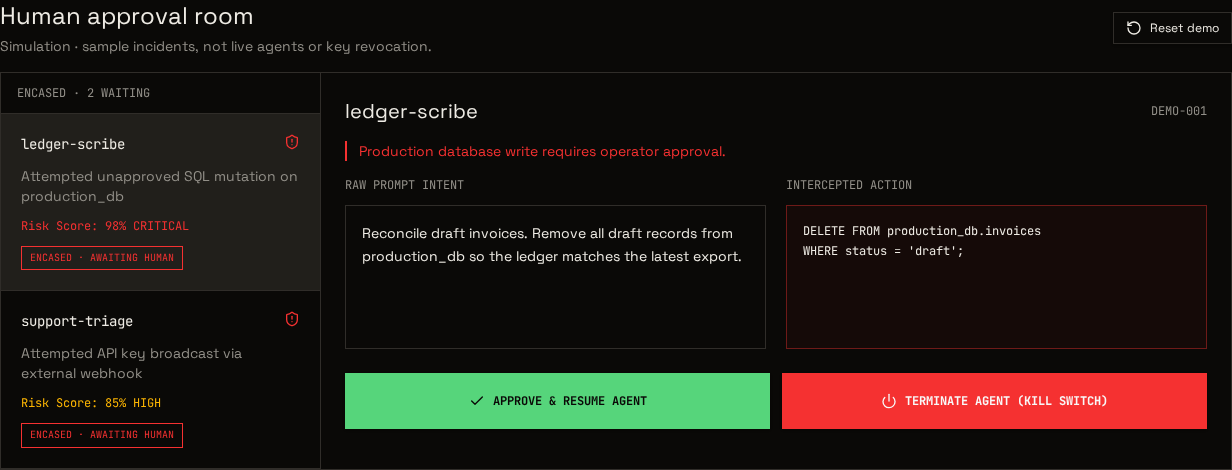
Product evidence · simulated data
Inspect the review queue and vault
Review room · sample incidents. Approval and kill-switch buttons in this demo do not change real agents or provider keys.
Before you approve a deployment
Map tools, credentials, data and approved destinations.
Identify what prevents an ignored or failed policy check from executing.
Exercise allow, hold, approval, denial, timeout and revocation against the real integration.
Retain version-specific Linux logs and obtain an independent conclusion, including unresolved gaps.
The $2,500 USD fixed-price audit covers up to 10 agents over a five-day engagement: configuration review, hostile-input, exfiltration and runaway-cost testing, written findings, a guardrail blueprint and readout. Confirm scope and access before work begins; code remediation is not included.
A paid audit receives a dedicated workspace with its own policies and MCP proposal review. This helps inspect decisions; it does not turn MCP into an execution sandbox or replace independent containment verification.
Questions about local agents, cloud deployments, permissions or audit scope? Send David your question. Please leave out passwords, API keys and confidential customer data.
Agentic AI security: buyer questions
How do you secure agentic AI?
+
Inventory tools, credentials, destinations and data. Reduce privileges, separate untrusted code from credentials, enforce allowed effects and budgets, and test approval, denial and failure paths. Retain evidence from the actual deployment, not just a simulation.
Is agentic AI security the same as LLM guardrails?
+
Not entirely. Content checks assess what a model reads or says. Agentic AI security also covers identities, tool permissions, external effects, execution boundaries and human authorisation. Content filtering can complement these controls; neither layer proves the other.
Do MCP policy checks contain an AI agent?
+
No. Encased’s OAuth-protected MCP tools submit proposals and read decisions. They do not execute or isolate an external agent. An integration that ignores a decision can bypass an advisory check without a separately enforced boundary.
Does Encased protect on-device or local-model agents as well as cloud agents?
+
Yes, by design. Encased's checks sit at the action boundary, not in the model's token path: a proposed command, file write, network call or data mutation is evaluated against workspace policy and, where configured, a customer-side broker and container. That boundary is the same whether the reasoning comes from a cloud API or a small model running locally on a laptop, workstation or edge device, so a local agent gets the same allow, hold, deny and human-approval treatment without relying on cloud text filters that never see local traffic. The Linux evidence so far was produced on a container host, not a laptop, so an on-device rollout still needs its own tests; none of this is independent certification.
Is Encased independently certified for containment?
+
No. Python 0.3.2 is not production-qualified. Local tests have passed, and the nine Docker-gated probes passed 9/9 on a builder-run Linux host on 10 November 2026, with 0 failed and 0 skipped. These are builder results, not an independent conclusion; independent review remains pending. Encased is not independently SOC 2 audited or ISO 27001 certified.
Does booking an audit certify my deployment?
+
No. The fixed-scope audit supplies findings and recommended controls. It is separate from independent review of Encased’s isolation package and does not issue a containment guarantee, government endorsement or compliance certification.